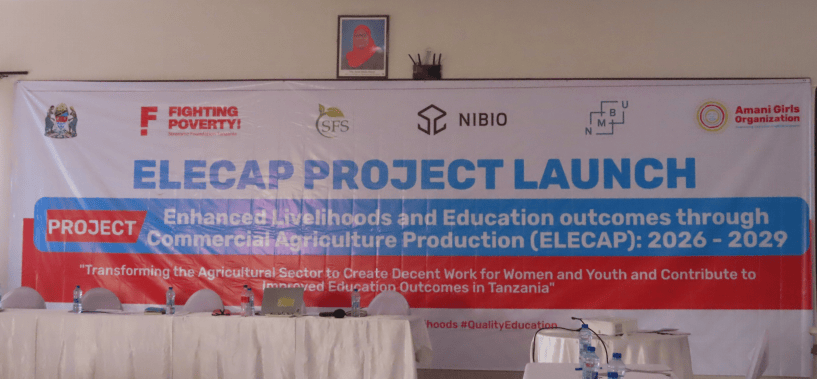
ELECAP Project, Tanzania
Location: Iramba, Ikungi and Manyoni Districts, Singida Region
Target Farmers: 6,000 (additional on the ELCAP)
Project Duration: 2026 to 2029
The Project; Enhancing Livelihoods and Education Outcomes through Commercial Agricultural Production (ELECAP) is an extended project building on the project; Enhanced Livelihoods for Commercial Agricultural Production (ELCAP) project which came to an end June 2026
The ELECAP project aims to improve the livelihoods and resilience of 6,000 smallholder farmers (50% youth, 70% women, and 1% PWD) by supporting a transition from subsistence agriculture to climate-resilient, market-oriented, and nutrition-sensitive farming systems. The project promotes climate smart agriculture, agroforestry including Gliricidia, and biochar to improve soil health, water retention, and carbon sequestration. These practices reduce land degradation, nutrient leaching, strengthen resilience to climate shocks, and support greenhouse gas mitigation while providing biomass for biochar and carbon credit opportunities.
The ELECAP Project will continue to upscale aiming to;
- Improve the lives of additional 6,000 smallholder farmers in Tanzania by strengthening support structures to commercialize maize, pigeon peas, sorghum, and sunflower value chains.
- Implement Climate Smart Agricultural (CSA) Practices for improved crop yields: Minimum tillage, crop rotation, and residue retention.
- Introduce biochar, engineered charcoal from pigeon pea residues, maize cobs, and other agricultural waste. Biochar combats climate change and retains soil water and soil nutrients.
- Link smallholder farmers, particularly women and youth in the target communities, to income opportunities along the improved value chains through capacity building and training.
- Translate production gains into income, and strengthen market systems through farmer owned cooperatives called AMCOS, improved post-harvest handling, agro-processing, and market linkages.
The Climate Smart Farming Solutions (CSFS) as a Technical implementing partner will continue to provide CSA and Biochar training to ToTs of implementing partners and will support technical design, quality assurance, and validation of CSA practices, including Gliricidia and biochar.
Partners include: Fighting Poverty! Strømme Foundation – Lead; Amani Girls Organization (AGO) – Community Partner; Government (Ministry of Agriculture and Local Government Authorities); Sokoine University of Agriculture (SUA) – Technical Partner; Norwegian Institute of Bio-economy Research (NIBIO) and Norwegian University of Life Science (NMBU) – Technical Partners